
Three suspected poachers were apprehended in Assam's Lakhimpur district for allegedly planning to poach rhinos in the Kaziranga National Park.

The Assam government has asked the CBI to probe the recent increase in rhino poaching in protected areas of the state.
Concerned over the recent frequent incidents of rhino poaching in Kaziranga National Park and other places in the state, the Assam government has moved the government to entrust the Central Bureau of Investigation to probe into a suspected conspiracy of certain forces with vested interests behind killing of the precious animal for its horn.
Three persons, including two former terrorists, have been arrested for their alleged involvement in recent incidents of rhino poaching in Kaziranga National Park.

Four individuals have been apprehended in Arunachal Pradesh's Papum Pare district for trafficking a rhinoceros horn valued at approximately Rs 1.2 crore. The operation, conducted in collaboration with the forest department, underscores the government's commitment to wildlife protection and combating organised crime.
The situation of the Indian rhinos remains precarious as global market pressures continue to push the demand for their horns, currently valued at about $37,000 per kilo in international market. Until recently, an average of five to ten rhinos were killed each year, but a rise in the number has been recorded recently.
As the state Wildlife and Forest Department's all 'efforts to gear up vigil in the habitats of endangered one-horned Asiatic rhinoceros' has come to a naught, the All Assam Students Union alleging nexus between rhino poachers and a section of people in power in the state has demanded an investigation by the Central Bureau of Investigation into incidents of rhino poaching in the state.

Kaziranga remains a critical stronghold for tiger conservation in India, but the recent deaths underscore the growing challenges of managing a thriving population within a limited landscape.
The wildlife staff manning the world famous rhino abode at Kaziranga National Park, a world heritage site in Assam, have found themselves groping for a way to tackle marauding poachers.
In the wake of a spurt in the killing of the one-horned rhinoceros in the famed Kaziranga National Park and other places in Assam, the state government has transferred the divisional forest officer of the park Dibyadhar Gogoi.

Dr Sonali Ghosh, the first woman to head the Kaziranga National Park and the first Indian to win the IUCN's Kenton Miller Award, has turned her childhood love for nature into an inspiring career in wildlife protection and leadership.

Assam Environment and Forest Minister Rakibul Hussain has said that as many as 193 one-horned rhinos have been killed in various protected forest areas in Assam between 2001 and August 3, 2014.

Prime Minister Narendra Modi on Sunday accused the Congress of handing over Assam's land to infiltrators for votes during its rule in the northeastern state.
Poachers gunned down a full-grown female rhino in the famous Assam Kaziranga National Park and took way her horn in the wee hours of Tuesday morning.

With rhino poachers creating havoc in the Kaziranga National Park, the Assam government has sent a proposal to the Union government for raising a Rhino Protection Force with more than 1,200 personnel while National Investigative Agency's help would be sought to bust the international rhino-poaching racket.

Minister of State for Environment and Forests Anil Dave gave these figures to the Lok Sabha on Tuesday.

The Centre will create a Special Rhino Protection Force in Assam to protect the animal from poaching and form a task force to enquire into encroachment of forest land in the state, Union Environment and Forests Minister Prakash Javadekar said on Saturday.

Union Minister of Environment and Forest Prakash Javadekar on Friday expressed anguish over the unabated poaching of the rare one-horned rhinoceros in Assam's Kaziranga National Park and the rapid shrinking of forest cover in the northeast region.
On the day when a private university in Assam organised a unique walkathon -- The Great Save Rhino Walkathon 2013 -- to raise awareness for protecting the one-horned rhinoceros in the state, poachers made mockery of the event by killing another precious rhino in Kaziranga National Park and took away its horn before the dawn on Sunday.

Dehorning grabs the spotlight again after the death of the last male northern white rhino.

India vice-captain Rohit Sharma is launching Rohit4Rhinos campaign, in partnership with WWF India and Animal Planet, to help build awareness for the need to conserve the Indian Rhino.

Facing flak for its failure to check unabated poaching of one-horned rhinoceros in Kaziranga National Park the Assam government has sought public opinion on its intention to launch a pilot project of dehorning (trimming) rhinos.

This has brought the total number of rhinos killed in KNP this year to six.

The 45-year-old rhino named Sudan had been in poor health in recent days and was being treated for age-related issues and multiple infections.
Three more rhinos were found dead on Monday in the flood waters of the Kaziranga National Park which has witnessed a sudden rise in poaching activities in the last few weeks.
One more rhinoceros was found dead on Saturday in the flood waters at Assam's Kaziranga National Park. While a total of six rhinos have died in the past four days in poaching and flood-related incidents, the toll since the third wave of floods began on September 21 has gone up to 10.
A recent report warns that the world's rhinos could vanish in the next two decades if rampant poaching isn't curbed.
A painstaking effort is on to bring the one-horned rhino back to Assam's Manas National Park, the place it once inhabited

On his part Rohit said, "I will be donating for this cause as I am so happy to find out what kind of work is being done by Mr Hameed and Mr Yakub to carry on this anti-poaching drive," said Rohit.
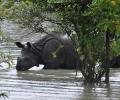
'Flooding forces the animals to disperse out of the park that, in turn, attracts the attention of poachers.'

Heavy flooding has caused animals at Kaziranga and Pabitora to move to higher land, making them more vulnerable to poaching.
Killings of the rare pachyderm are on the rise in Assam with 15 falling victim to poachers, who hunt them down for their horns, since January in the Kaziranga National Park alone. K Anurag reports

What would it be like to be the last man on earth? Many have pondered over the question never to have found an answer. If only Sudan could speak he could have solved that philosophical quandary.

He said that those who have surrendered and returned to the mainstream are being rehabilitated by both the central and Assam governments and they will participate in the development journey of the state.

His death puts the species on the very edge of extinction.

These natural wonders are all under threat.

The army, SDRF and NDRF are assisting the district administrations in evacuating the affected population to safer places, the authority said.
An unmanned aircraft on Monday hovered over for about 30 minutes over the Kaziranga National Park in Assam after state Forest Minister Rakibul Hussain inaugurated the test flight, ushering in an era of hi-tech anti-poaching measures at the UNESCO World Heritage Site.
Lack of modern weapons for forest guards has proved to be a major roadblock in tackling the increasing incidents of poaching in Assam.
